
How a Traditional Favourite
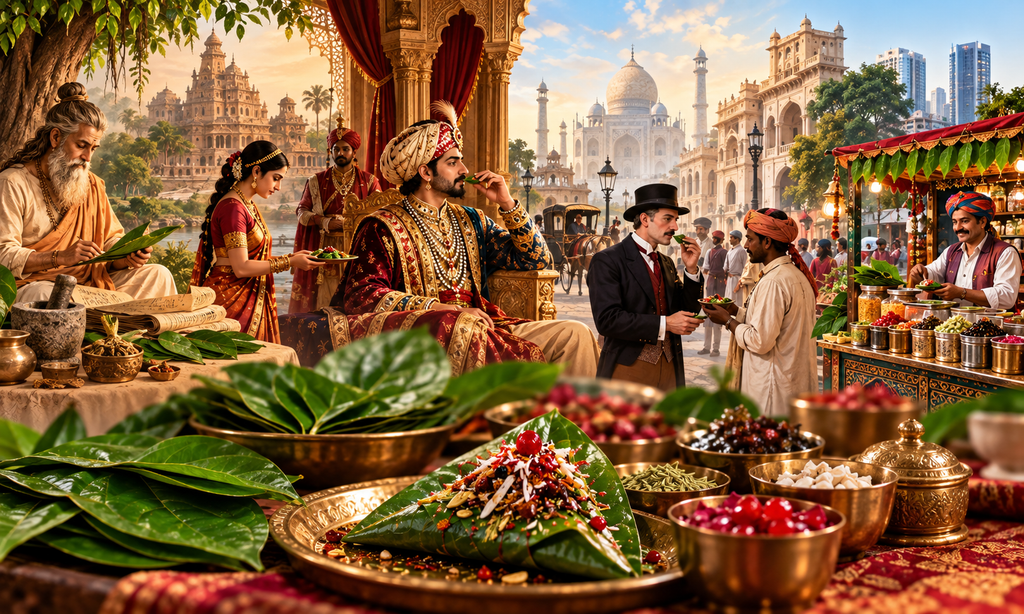
Few Indian traditions are as easy to recognize as a neatly folded paan.
A green betel leaf, carefully spread with its fillings, folded into a small triangle or parcel, and served after a meal has been part of Indian social life for centuries. For some people, paan is associated with hospitality. For others, it brings back memories of family gatherings, weddings, festivals, old markets, or the traditional paan shop that once stood at the corner of a busy street.
But paan is much more than a familiar after-meal preparation.
Its story stretches across centuries and connects agriculture, trade, Ayurveda, cuisine, courtly culture and everyday social customs. The paan people know today is also very different from the preparations that existed centuries ago. Ingredients changed, regional preferences developed, new flavours appeared, and eventually modern paan shops began creating entirely new interpretations.
So where did this tradition begin? How did a simple combination of leaves and other ingredients become such an important part of Indian culture?
The complete story is more interesting than it may first appear.
What exactly is paan?
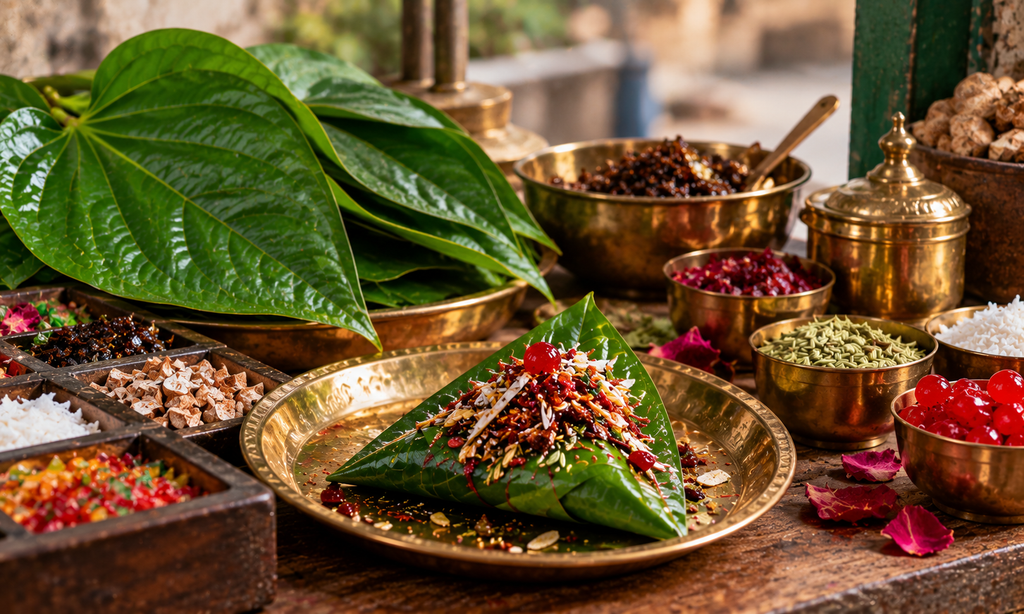
Before looking at its history, it helps to understand what the word paan means.
The word is commonly used for both the betel leaf and the preparation made by wrapping different ingredients inside that leaf. In its traditional form, the preparation can contain betel leaf, areca nut (supari), slaked lime (chuna), and catechu (katha), along with ingredients such as cardamom, cloves, fennel, coconut, sweeteners and other regional additions.
There is no single recipe that defines paan across India.
That is one of the reasons its history is so fascinating.
A paan prepared in one part of India may look and taste completely different from one prepared somewhere else. Some versions are sweet, some are strongly aromatic, some emphasize spices, while others focus on the natural flavour of the leaf and areca nut.
The modern word therefore covers a remarkably broad family of preparations rather than one fixed recipe. Scientific and historical literature also notes that the ingredients and preparation of betel quid vary considerably between regions and cultures.
How old is the tradition of paan?
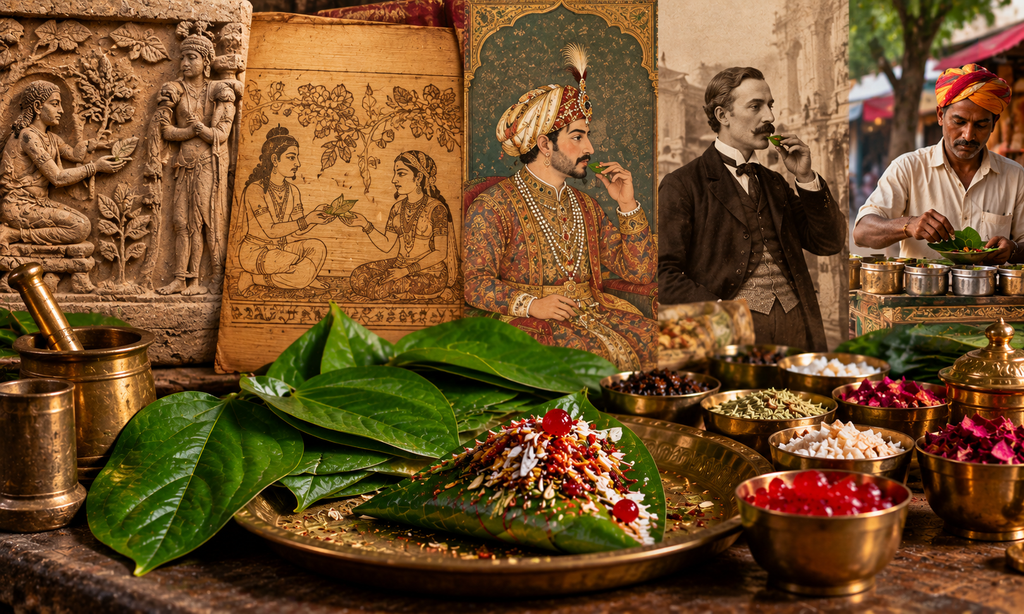
This is where the history becomes particularly interesting.
There is strong evidence that chewing areca nut and preparations involving betel have been practiced for a very long time across South and Southeast Asia. Archaeological evidence and the staining found on ancient teeth suggest that areca use goes back to prehistoric periods, although this does not mean that the exact modern form of paan existed at that time.
In other words, we should be careful when saying that “paan was invented” on a particular date.
There probably was no single person, place or moment when paan suddenly appeared.
Instead, the tradition developed gradually as people discovered, cultivated and combined different plants and ingredients.
Ancient Indian texts provide some of the clearest historical clues.
The Sushruta Samhita, an important Sanskrit medical text traditionally associated with the ancient Indian medical tradition, contains references to betel-related practices. Historical sources also identify the Sanskrit term tambula for the betel leaf.
Some research on betel leaf in India places its use in ancient times and describes references in Ayurvedic literature. It also notes that the practice of chewing betel leaf after meals became established over the early centuries of the Common Era.
What this tells us is important: paan was not simply a recent food trend. Its roots belong to a much older tradition.
Paan and the Indian tradition of finishing a meal
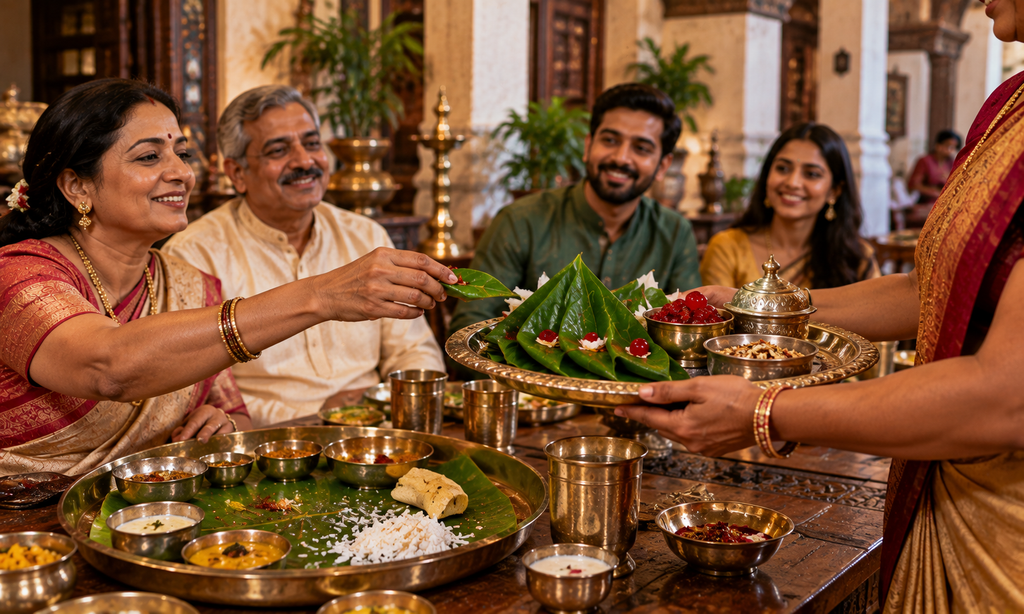
One of the most enduring associations of paan is with the end of a meal.
In traditional Indian households and social settings, meals were not always considered complete when the main dishes disappeared from the table. There were often preparations associated with the conclusion of a meal, and betel leaf became part of that wider food culture.
Why?
Part of the answer lies in the ingredients and flavours traditionally associated with paan.
Betel leaf has a distinctive aroma. Cardamom, cloves, fennel, spices and other additions can give a preparation a fresh and fragrant character. Depending on the recipe, sweet ingredients can also soften the stronger flavours of areca nut and other components.
Over time, serving paan after food became more than a matter of taste.
It became a social gesture.
Offering paan could be a way of welcoming a guest, extending hospitality or bringing a gathering to a pleasant close.
This social role helped paan survive far beyond the boundaries of a particular recipe.
From everyday habit to a symbol of hospitality
Indian hospitality has always involved food.
Guests may be welcomed with water, tea, sweets, snacks or a meal. In many communities, paan became another part of this tradition.
A guest being offered paan was not necessarily being offered just something to chew. It could represent generosity and respect.
Historical accounts show that betel was associated with social exchange and hospitality in different parts of Asia. The ingredients and customs varied from one region to another, but the act of offering betel often carried social meaning.
This helps explain why paan became connected with important occasions.
Weddings, festivals, family celebrations and formal gatherings all provided opportunities for paan to be served.
The small folded leaf could therefore play a surprisingly large role in social interaction.
Paan in royal courts and elite society
As Indian kingdoms and courts developed, paan also became associated with royal and elite culture.
The preparation of paan could become elaborate.
Different ingredients were carefully selected. Fragrant spices and flavourings could be added, and the preparation and presentation could become part of the experience itself.
Historical accounts later recorded the custom among Indian rulers and nobles. Marco Polo, writing about India in the late 13th century, described people keeping a leaf called “tembul” in their mouths, providing one of the well-known external accounts of the practice.
The important point is not that paan belonged only to royalty.
It did not.
Rather, courtly culture helped develop the idea of paan as something that could be prepared with considerable attention to ingredients, presentation and ceremony.
Over time, versions of these practices became part of wider society.
Regional India created many different kinds of paan
One of the biggest reasons paan remained relevant for so long is that India never treated it as a single fixed recipe.
Different regions developed their own preferences.
Climate, agriculture, local ingredients, trade routes and cultural traditions all influenced what people put inside the leaf.
In one place, sweet flavours might dominate.
In another, spices and aromatic ingredients might be more important.
Elsewhere, the preparation might emphasize areca nut and traditional ingredients.
This regional diversity is one of the defining characteristics of Indian paan.
The betel leaf itself also varies. Different varieties are cultivated in different parts of India, and experienced paan makers can distinguish leaves by their size, texture, aroma, strength and flavour.
This is why describing paan simply as “a betel leaf with fillings” misses much of its cultural history.
The leaf is only the beginning.
The role of supari, chuna and katha
The role of supari, chuna and katha
Supari
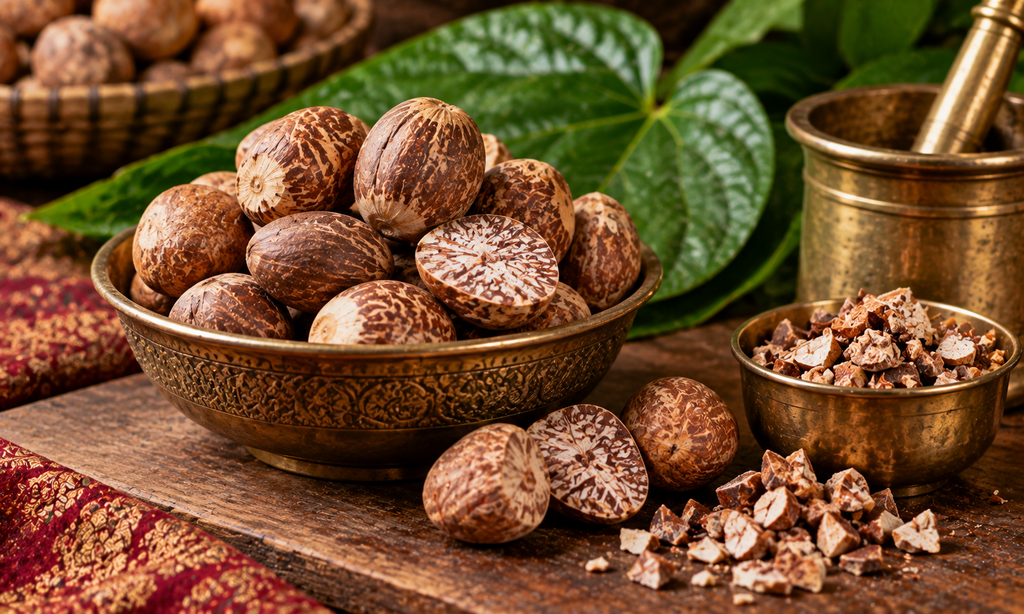
Supari is the commonly used Indian name for areca nut.
It provides a distinctive texture and flavour and has been an important component of many traditional betel preparations.
It is worth noting that “betel nut” is a commonly used expression, but the botanical term is areca nut, which comes from the areca palm, Areca catechu.
Chuna
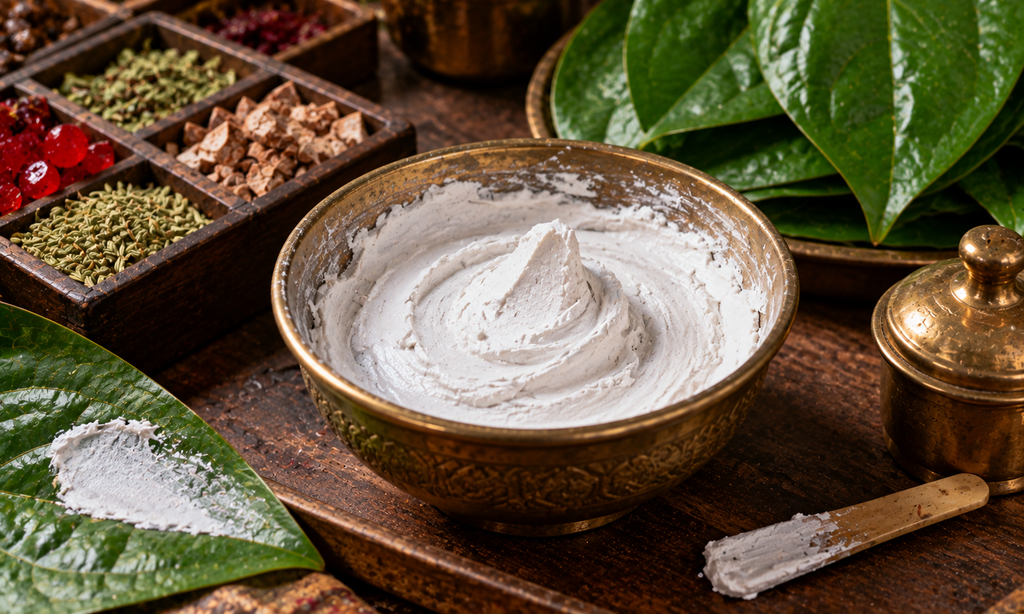
Chuna refers to slaked lime, traditionally applied in a very small quantity to the leaf.
It is an important component of traditional betel quid preparation because it changes the chemical environment of the mixture and affects the extraction of compounds from the ingredients.
Katha
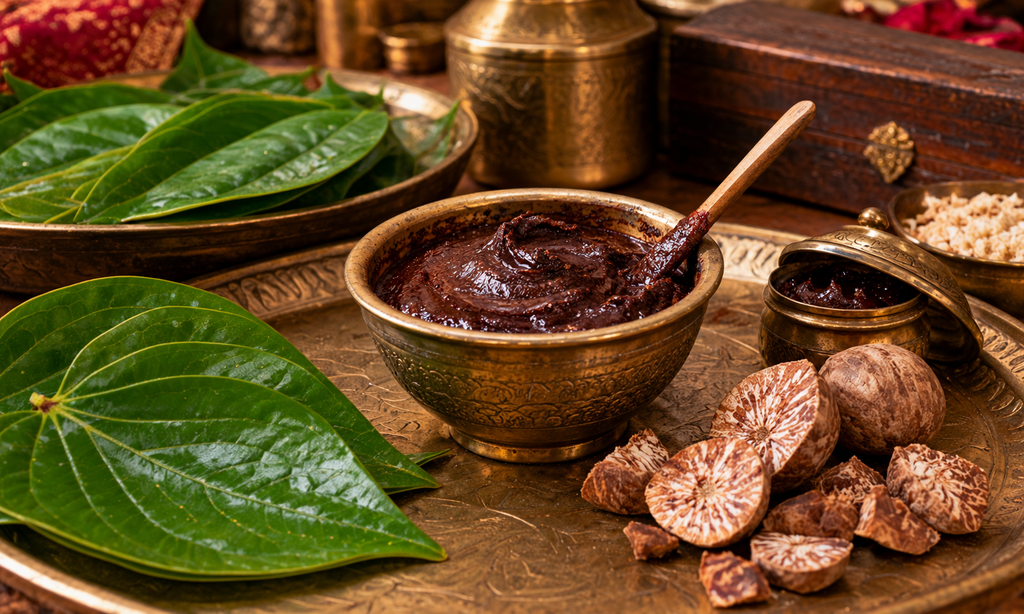
Katha, or catechu, is a plant-derived ingredient traditionally used in paan. It contributes colour, flavour and astringency.
Together, these ingredients created the foundation from which countless regional preparations developed.
But paan was never limited to these ingredients.
That is where things become even more interesting.
Spices, flowers, nuts and sweet ingredients changed the experience
As paan developed, people began adding ingredients according to local taste.
Cardamom could contribute fragrance.
Cloves could add warmth.
Fennel could bring a sweet, aromatic note.
Coconut, rose-flavoured ingredients, dried fruits and other additions could create completely different flavour profiles.
Sweet paan eventually became especially popular.
Instead of treating paan primarily as a strong traditional chew, sweet preparations allowed people to enjoy the fragrance, texture and flavours of the leaf together with ingredients such as gulkand, coconut, fennel and other sweet components.
This development is important because it shows how adaptable paan has always been.
It was not frozen in one historical form.
It changed according to the people eating it.
When tobacco became part of paan
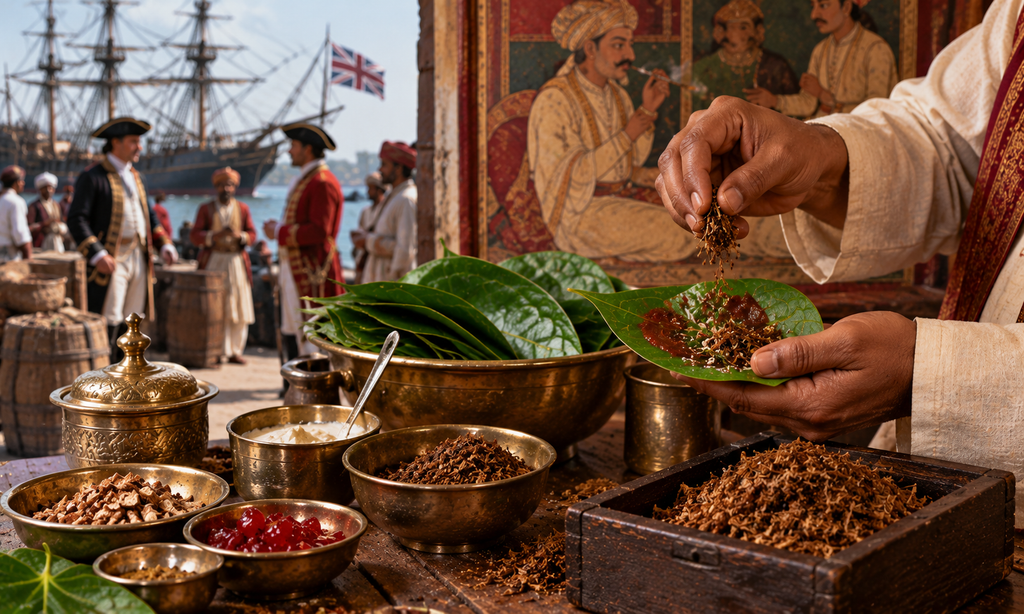
An important chapter in the history of paan came much later.
Tobacco was not an original ingredient of the ancient betel tradition.
Tobacco reached India after contact with Europeans in the 16th century. Over time, tobacco use spread and became incorporated into some forms of betel chewing.
This created a major distinction between different types of paan and chewing preparations.
Not every paan contains tobacco.
Traditional sweet paan, for example, is generally prepared without tobacco.
This distinction matters when discussing the history of paan because modern discussions sometimes treat paan, tobacco-containing betel quid, pan masala and gutka as though they are all identical.
They are not.
The ingredients and preparation can be substantially different.
Paan and the rise of pan masala
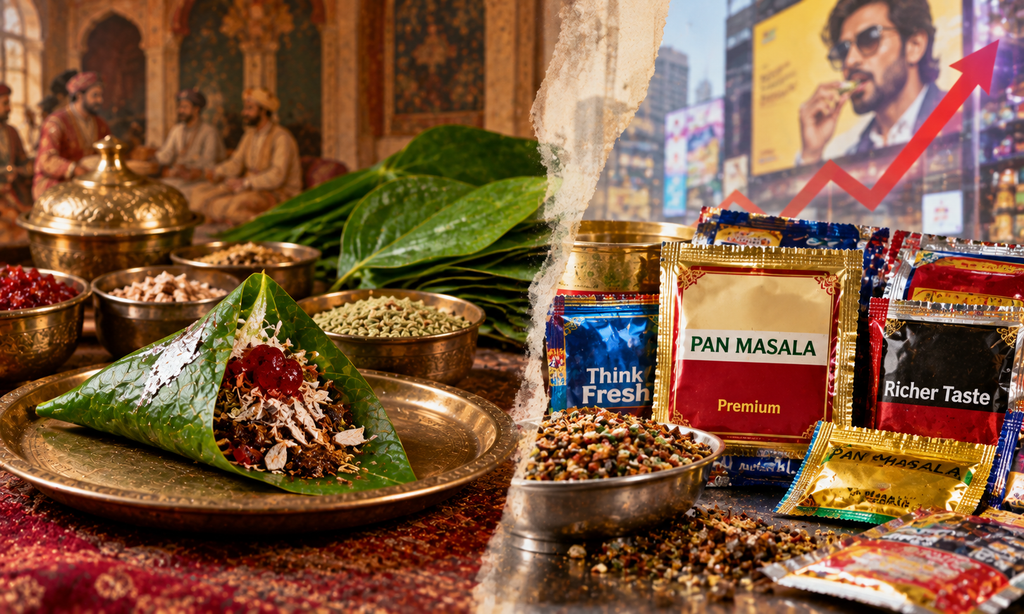
The 20th century brought another major change.
Instead of preparing a fresh leaf-based quid each time, commercially packaged mixtures began appearing.
Pan masala developed as a packaged preparation generally containing ingredients such as areca nut, catechu, lime and flavourings, but without tobacco. Tobacco-containing preparations developed separately, including gutka.
The commercialization of these products changed how areca-based preparations were packaged, marketed and consumed. Historical reviews place the emergence of commercial pan masala and gutka products in the late 1960s and early 1970s, followed by extensive marketing in subsequent decades.
This was a significant departure from the traditional paan shop.
A fresh paan was made individually.
A packaged product could be produced at scale, carried easily and stored for longer.
That difference reflects a much larger transformation in Indian food culture: traditional preparations increasingly encountered modern manufacturing and mass marketing.
The paan shop became part of everyday India
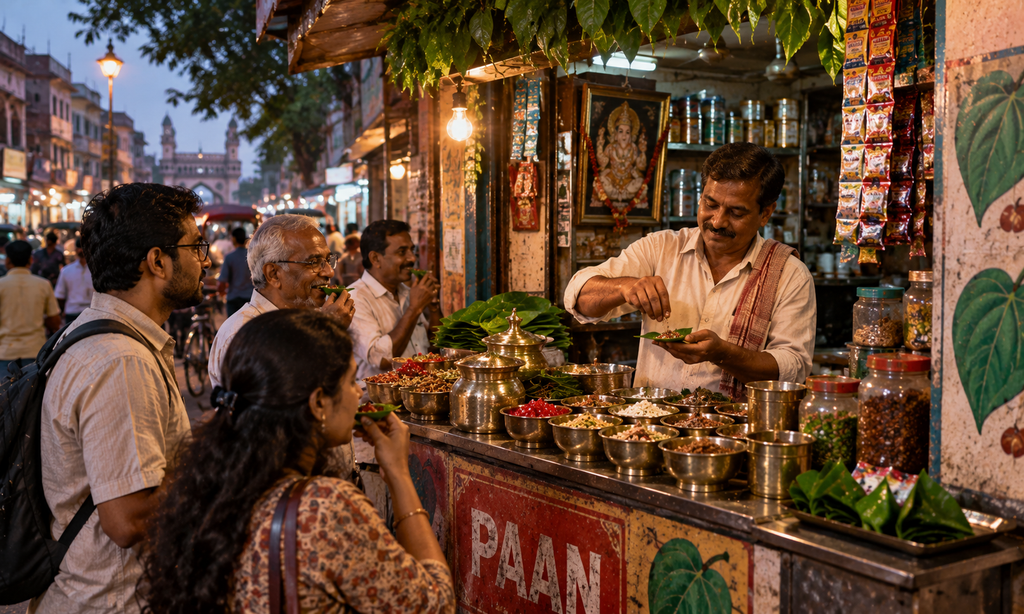
For generations, the paan shop has occupied a distinctive place in Indian streetscape.
Often small in size, a paan shop can become a meeting point.
People may stop for a paan after dinner, talk with friends, ask for a particular flavour, buy mukhwas or simply spend a few minutes in conversation.
This is one reason paan cannot be understood only as a food.
The shop itself became part of the culture.
The paanwala developed knowledge that went beyond simply folding a leaf.
A good paan maker needs to understand the condition of the leaf, how much of each ingredient to use, how the ingredients balance one another and how to fold the final preparation so that it holds together.
For regular customers, the relationship could become personal.
“Make it like last time” might be enough instruction.
That kind of familiarity is difficult to reproduce in a factory-made product.
How paan became part of weddings and celebrations
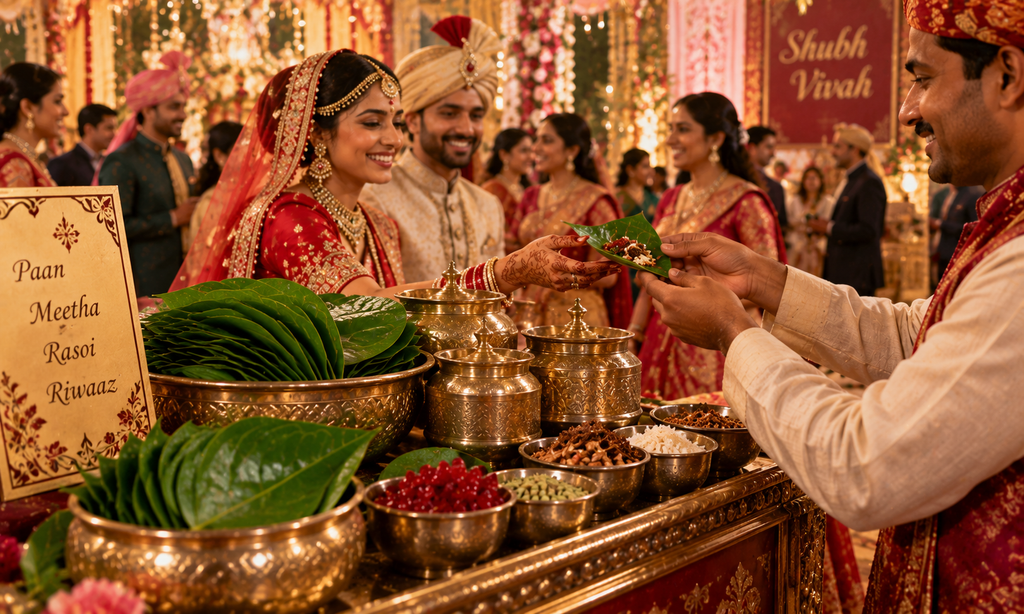
Walk into many Indian wedding traditions and you will find that food is rarely only about feeding people.
Presentation matters.
Flavours matter.
Ritual matters.
Memory matters.
Paan fits naturally into that environment.
Paan counters became increasingly common at weddings and events, where guests could choose from different varieties and watch preparations being made.
The traditional leaf could be decorated, shaped and presented as part of the occasion.
Sweet paan became particularly suitable for such settings because its flavours appealed to people who might not normally eat stronger traditional preparations.
In this way, paan moved beyond the traditional paan shop and became part of event catering and celebration culture.
The evolution of sweet paan
Sweet paan deserves special attention because it represents one of the clearest examples of how the tradition adapted.
Traditional paan could have strong, earthy and aromatic flavours.
Sweet paan offered a different experience.
Ingredients such as gulkand, fennel, coconut, candied fruits and other sweet additions could transform the character of the preparation.
Later generations of paan makers experimented even further.
Chocolate, dry fruits, cherries, flavoured fillings and other modern ingredients began appearing in contemporary paan menus.
Some modern versions are barely recognizable compared with the traditional paan of earlier centuries.
Yet they still use the same fundamental idea:
From traditional paan to modern paan
Today, paan exists at several different levels.
At one end is the traditional preparation made using familiar ingredients and regional techniques.
At another are modern sweet and dessert-style paans created for younger customers and special occasions.
There are also premium paan counters where presentation has become almost as important as flavour.
Some preparations are designed to be visually striking.
Others focus on ingredients.
Some are deliberately nostalgic, attempting to recreate the taste of an older style of paan.
This is not necessarily the disappearance of traditional paan.
It is another stage in its evolution.
Food traditions survive partly because they change.
If a recipe never adapts to changing tastes, it can become a historical curiosity. Paan has remained culturally visible precisely because generations of makers and customers have found new ways to enjoy it.
Paan in Delhi
Delhi has its own relationship with paan.
The city has historically brought together people, cuisines and traditions from many parts of India. Its markets and neighbourhoods have long included small food businesses serving both traditional and changing tastes.
The Delhi paan experience therefore reflects the wider evolution of the city.
You can find preparations rooted in traditional recipes alongside modern interpretations designed around sweetness, presentation and convenience.
For many people, a paan is still connected to familiar social rituals: finishing a meal, meeting friends, celebrating an occasion or stopping at a favourite shop.
That mixture of old and new is perhaps the most interesting part of paan culture today.
Paan is more than a recipe
If we look at the entire history of paan, one thing becomes clear.
Its survival cannot be explained simply by flavour.
Paan became part of Indian culture because it occupied many roles at the same time.
It was connected with food.
It was connected with hospitality.
It became associated with social interaction.
It appeared in courtly settings.
It became part of celebrations.
It developed strong regional identities.
And eventually, it adapted to modern tastes and businesses.
The recipe changed, but the social meaning often remained.
That is why a small folded leaf can carry so much cultural memory.
Experienced Yamus Panchayat Paan
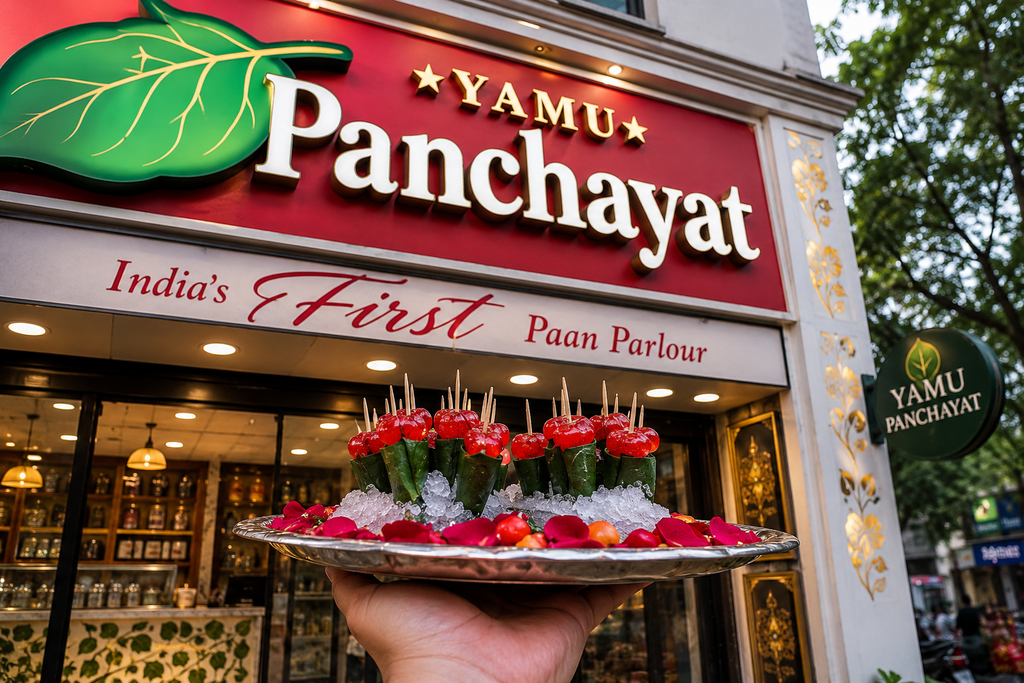
Paan has travelled through centuries of Indian history, changing with generations while keeping its connection to tradition, hospitality, and celebration. Today, every variety tells a slightly different story, from classic preparations to modern flavours created for changing tastes.
If you are in Delhi and want to experience this timeless tradition for yourself, come visit Yamu’s Panchayat. We welcome you to discover the flavours, craftsmanship, and culture that make paan such a memorable part of India’s food heritage.